

How To Set A Marker In Adobe Premiere
- Adobe Premiere Pro User Guide
- Beta releases
- Beta Program Overview
- Premiere Pro Beta Domicile
- Getting started
- Get started with Adobe Premiere Pro
- What's new in Premiere Pro
- Release Notes | Premiere Pro
- Keyboard shortcuts in Premiere Pro
- Accessibility in Premiere Pro
- Get started with Adobe Premiere Pro
- Hardware and operating system requirements
- Hardware recommendations
- Organization requirements
- GPU and GPU Driver requirements
- GPU Accelerated Rendering & Hardware Encoding/Decoding
- Hardware recommendations
- Creating projects
- Starting time a new project
- Open projects
- Move and delete projects
- Piece of work with multiple open projects
- Work with Projection Shortcuts
- Backward compatibility of Premiere Pro projects
- Open and edit Premiere Blitz projects in Premiere Pro
- Best Practices: Create your own project templates
- Workspaces and workflows
- Workspaces
- FAQ | Import and consign in Premiere Pro
- Working with Panels
- Windows touch and gesture controls
- Use Premiere Pro in a dual-monitor setup
- Workspaces
- Capturing and importing
- Capturing
- Capturing and digitizing footage
- Capturing HD, DV, or HDV video
- Batch capturing and recapturing
- Setting upwardly your organisation for Hard disk, DV, or HDV capture
- Capturing and digitizing footage
- Importing
- Transfer files
- Importing still images
- Importing digital sound
- Importing from Avid or Terminal Cut
- Importing AAF project files from Avid Media Composer
- Importing XML project files from Final Cut Pro 7 and Final Cutting Pro Ten
- Importing AAF project files from Avid Media Composer
- Supported file formats
- Digitizing analog video
- Working with timecode
- Capturing
- Editing
- Sequences
- Create and change sequences
- Add clips to sequences
- Rearrange clips in a sequence
- Observe, select, and group clips in a sequence
- Edit from sequences loaded into the Source Monitor
- Simplify sequences
- Rendering and previewing sequences
- Working with markers
- Scene edit detection
- Video
- Create and play clips
- Trimming clips
- Synchronizing audio and video with Merge Clips
- Render and supervene upon media
- Disengage, history, and events
- Freeze and hold frames
- Working with attribute ratios
- Create and play clips
- Sound
- Overview of audio in Premiere Pro
- Audio Track Mixer
- Adjusting volume levels
- Edit, repair, and ameliorate audio using Essential Audio console
- Automatically duck audio
- Remix audio
- Monitor prune volume and pan using Audio Clip Mixer
- Audio balancing and panning
- Advanced Audio - Submixes, downmixing, and routing
- Audio effects and transitions
- Working with audio transitions
- Apply effects to audio
- Measure audio using the Loudness Radar effect
- Recording audio mixes
- Editing audio in the timeline
- Audio aqueduct mapping in Premiere Pro
- Employ Adobe Stock sound in Premiere Pro
- Overview of audio in Premiere Pro
- Avant-garde editing
- Multi-camera editing workflow
- Editing workflows for feature films
- Fix and apply Head Mounted Brandish for immersive video in Premiere Pro
- Editing VR
- Multi-camera editing workflow
- Best Practices
- Best Practices: Mix audio faster
- All-time Practices: Editing efficiently
- Best Practices: Mix audio faster
- Sequences
- Video Furnishings and Transitions
- Overview of video effects and transitions
- Effects
- Types of effects in Premiere Pro
- Utilize and remove effects
- Effect presets
- Automatically reframe video for different social media channels
- Colour correction effects
- Change elapsing and speed of clips
- Adjustment Layers
- Stabilize footage
- Transitions
- Applying transitions in Premiere Pro
- Modifying and customizing transitions
- Morph Cut
- Graphics, Titles, and Animation
- Graphics and titles
- Overview of the Essential Graphics panel
- Create a title
- Create a shape
- Align and distribute text and shapes
- Check spelling and Detect and Replace
- Apply text gradients in Premiere Pro
- Add Responsive Design features to your graphics
- Use Motility Graphics templates for titles
- Replace images or videos in Movement Graphics templates
- Use data-driven Motility Graphics templates
- Best Practices: Faster graphics workflows
- Working with captions
- Voice communication to Text
- Oral communication to Text in Premiere Pro | FAQ
- Upgrade Legacy titles to Source Graphics
- Overview of the Essential Graphics panel
- Animation and Keyframing
- Calculation, navigating, and setting keyframes
- Animating furnishings
- Use Motion consequence to edit and animate clips
- Optimize keyframe automation
- Moving and copying keyframes
- Viewing and adjusting effects and keyframes
- Calculation, navigating, and setting keyframes
- Graphics and titles
- Compositing
- Compositing, alpha channels, and adjusting clip opacity
- Masking and tracking
- Blending modes
- Compositing, alpha channels, and adjusting clip opacity
- Colour Correction and Grading
- Overview: Color workflows in Premiere Pro
- Machine Colour
- Get creative with color using Lumetri looks
- Adjust color using RGB and Hue Saturation Curves
- Correct and match colors between shots
- Using HSL Secondary controls in the Lumetri Color panel
- Create vignettes
- Looks and LUTs
- Lumetri scopes
- Brandish Color Direction
- HDR for broadcasters
- Enable DirectX HDR support
- Exporting media
- Export video
- Export Preset Managing director
- Workflow and overview for exporting
- Quick export
- Exporting for the Web and mobile devices
- Export a withal image
- Exporting projects for other applications
- Exporting OMF files for Pro Tools
- Consign to Panasonic P2 format
- Export settings reference
- Best Practices: Export faster
- Collaboration: Frame.io, Productions, and Team Projects
- Collaboration in Premiere Pro
- Frame.io
- Install and actuate Frame.io
- Use Frame.io with Premiere Pro and After Effects
- Ofttimes asked questions
- Productions
- Using Productions
- How clips piece of work beyond projects in a Production
- Best Practices: Working with Productions
- Squad Projects
- What's New in Squad Projects
- Get started with Team Projects
- Create a Squad Project
- Add and manage media in Team Projects
- Interact with Squad Projects
- Share and manage changes with Team Projection collaborators
- Archive, restore, or delete Team Projects
- Working with other Adobe applications
- After Effects and Photoshop
- Dynamic Link
- Audition
- Prelude
- Organizing and Managing Assets
- Working in the Project console
- Organize avails in the Project panel
- Playing assets
- Search assets
- Creative Cloud Libraries
- Sync Settings in Premiere Pro
- Consolidate, transcode, and archive projects
- Managing metadata
- Best Practices
- Best Practices: Learning from broadcast production
- All-time Practices: Working with native formats
- Best Practices: Learning from broadcast production
- Working in the Project console
- Improving Performance and Troubleshooting
- Set preferences
- Reset preferences
- Working with Proxies
- Proxy overview
- Ingest and Proxy Workflow
- Proxy overview
- Bank check if your organization is compatible with Premiere Pro
- Premiere Pro for Apple silicon
- Eliminate flicker
- Interlacing and field club
- Smart rendering
- Command surface support
- Best Practices: Working with native formats
- Knowledge Base
- Known problems
- Fixed bug
- Green and pink video in Premiere Pro or Premiere Blitz
- How do I manage the Media Cache in Premiere Pro?
- Set up errors when rendering or exporting
- Troubleshoot issues related to playback and performance in Premiere Pro
- Monitoring Avails and Offline Media
- Monitoring assets
- Using the Source Monitor and Program Monitor
- Using the Reference Monitor
- Offline media
- Working with offline clips
- Creating clips for offline editing
- Relinking offline medInstia
- Working with offline clips
- Monitoring assets
Add markers to clips, use markers to position and conform clips, re-create and paste markers, display marker comments, and share markers with After Effects.
Markers indicate important points in time and help you position and adapt clips. Y'all can use a marking to identify an important activeness or audio in a sequence or prune. Markers are for reference only and exercise not alter the video.
The following types of markers are available in Premiere Pro:
| A comment or annotation about the selected part of the Timeline. | |
| Chapter markers in the project allow viewers seeing the finished video use the markers to chop-chop spring to those points in the video. | |
| Segmentation markers assist you define ranges in the video to automate workflows. For example, you can identify certain areas equally being leader or as segment where commercials go. | |
| Add a URL that provides more info about the selected part of the movie clip. |
You can add together markers to a sequence, or to a source clip. Markers are color-coded for easier identification.
Markers panel
Use the Mark panel (Window > Markers) to see all the markers in an open clip or sequence. Details associated with clips such as colour-coded tags, In points, Out points, and comments are displayed. Clicking a clip thumbnail in the Markers console moves the playhead to the location of the corresponding mark.
Click a marker in the Markers panel, and then the playhead moves to that position of marker in the Timeline.
A marker on a clip or in a sequence shows the In and Out points in the Marker panel. You can scrub the In or Out betoken to turn the marker from a single frame in time to one roofing a range of time.
Add markers in the Timeline
You can add markers on the Source monitor, Program monitor, or on the Timeline. Markers added to Plan monitor are reflected in the Timeline. Similarly, markers added to the Timeline are reflected on the Program Monitor.
In Premiere Pro, multiple markers can be added, allowing a user to add multiple notes and comment on clips on the same location in the Timeline.
-
Motility the playhead to the point where you want to add together a marker.
-
Select Marker > Add Marking, or press the Thou key. The default color of a marker is green.
-
To edit the marker, double-click the marker icon to open the Marker dialog box.
You can create a keyboard shortcut to open the Marking dialog box.
-
Set whatever of the post-obit options:
Proper noun
Type a proper name for the marker.
Duration
Drag the duration value or click the value to highlight it, blazon a new value, and press Enter/Return. When using markers for URL links and chapter markers, you tin can fix sequence markers to be longer than i frame in elapsing.
Comments
Type a comment you want associated with the marker.
Chapter Marking
Check this box if you want to brand the mark a chapter marker.
Web Link
Check this box if you desire to acquaintance the mark with a hyperlink.
URL
This field is enabled only when Web Link is checked. Enter the accost of the web page y'all desire to open.
When the film is included in a web page and the marker is reached in the flick, the web page automatically opens. Web links work just with supported formats such every bit QuickTime.
Frame Target
This field is enabled merely when Web Link is checked. Enter the target frame for a web page if using an HTML frameset.
-
To enter comments or specify options for other sequence markers, click Prev or Next.
Add together markers to clips
Markers tin exist added to clips in the Source Monitor, or selected clips in the Timeline.
To add a marker to a clip in the Source Monitor, do the post-obit:
-
Open the clip in the Source Monitor from the Timeline or the Project panel.
-
Identify the Playhead where you want to identify the marker.
-
Cull Marker > Add Marker, or press M. The marker is added to the prune.
To add a marker to a clip in the Timeline, practice the following:
-
Ready a keyboard shortcut for Add Clip Marker in Edit > Keyboard Shortcuts (Windows), or Premiere Pro > Keyboard Shortcuts (macOS).
-
Select the clip. Place the Playhead where yous desire to place the marker.
-
Press the keyboard shortcut you created for Add Clip Mark. The marker is added to the clip.
Y'all can inspect the marking dialog box by double-clicking the marker in the Source Monitor.
Create markers in the Upshot Controls console
In the Effect Controls console, you lot tin can view all of the markers that you created in the Timeline panel. You tin also add together markers to your sequence to designate where you would like to place effects in the Event Controls panel. In add-on, you can create and dispense markers directly in the Outcome Controls console.
-
Drag the playhead to the place where you want to create a mark.
-
Right-click (Windows) or Control-click (Mac OS) in the timeline ruler. And so select Add Marker, or press the K key.
Change default marker colors
The default colour of a mark is green. To change this preference, you can ready keyboard shortcuts for each marker colour.
-
Open the Keyboard Shortcuts dialog box.
- In Windows, cull Edit > Keyboard Shortcuts.
- In macOS, choose Premiere Pro > Keyboard Shortcuts.
-
In the Control section, add keyboard shortcuts for each different marker color.

Adding keyboard shortcuts for unlike marking colors

Find, move, and delete markers
You lot can find markers by using the marker navigation tools. Y'all tin can move them from their original locations by dragging them, or yous tin can delete them altogether.
Navigate amidst markers
-
Practise one of the following:
- Select Marker > Go to Adjacent Marker.
- Select Marker > Go to Previous Marker.
Move a marker
-
- To move a clip marking in a clip that'south in a sequence, open the clip in the Source Monitor and drag the Marker icon
 in the Source Monitor'southward time ruler. (You can't manipulate clip markers in the Timeline panel).
- To movement a sequence mark, drag the marker in a Timeline panel or the Plan Monitor's time ruler.
- Dragging a mark in the Source or Programme Monitor's time ruler moves the corresponding marking icon in a Timeline panel.
Sequence markers in a nested sequence appear as clip markers (with a slightly unlike color) in the parent sequence and in the Source Monitor. To suit a nested marker, open the nested sequence in a Timeline panel, so drag the mark.
- To move a clip marking in a clip that'south in a sequence, open the clip in the Source Monitor and drag the Marker icon
Delete markers
-
- To delete a prune marking, cue the playhead to the clip mark, and then open the clip in the Source Monitor.
- To delete a sequence marker, cue the playhead to the mark.
-
To clear a mark, select Marker > Clear Selected Marker. To clear all the markers, select Marker > Clear All Markers.
When y'all employ the Clear All Markers option, Premiere Pro removes all sequence markers and all clip markers on selected clips.
You can't remove a sequence marker by dragging information technology away from the fourth dimension ruler.
Articulate a marker past right-clicking (Windows), or Ctrl-clicking (Mac OS) on a marking, and then choose Clear Current Marker from the context carte.
Prove and hide markers according to color
You can filter markers past color. Select the marker color from the Marker panel to brandish in the timeline,Marker panel, Program, Source, and Reference monitors, and the Effect Controls panel. If you practice not check whatsoever boxes, and then all markers are displayed.

 Premiere Pro does not remove whatsoever markers. It only hides the unchecked markers. You can ever display hidden mark colors by additionally selecting the desired color, or unchecking all boxes.
Things to keep in mind
- Adding a mark of a color that is hidden will make that marker color visible.
- This feature works on both prune and sequence markers at the same time.
- Use Markers > Show All Markers to apace make all markers visible.
- Certain marker commands but work on visible markers. For instance, if you want to articulate all markers of a specific color, display only those markers and then select Markers > Clear Markers . Only the displayed markers are cleared. Exporting markers likewise works only for displayed markers.
One time a mark is fix, hovering over it in the time ruler produces a tool tip which displays the marking information. Y'all tin quickly browse marker contents without opening the Marker dialog box.
The sequence marking tool tip displays the post-obit information on up to four items:
-
Marker name (optional, shown but if entered)
-
Timecode beginning (e'er displayed)
-
Duration (optional, shown only if the marker has a elapsing)
-
Comment text (optional, shown just if entered)
When the Show Audio Time Units pick is selected, the tool tips show marker location and duration in sound time units instead of timecode units.
Copy and paste sequence markers
You lot can include sequence markers when copying and pasting items from the timeline to bring all markers and their information forth with a unmarried copy/paste action. All marking information such equally color, notes, duration, marker type, is preserved during the copy/paste operation.
To include sequence markers during copy/paste, bank check Markers > Copy Paste Includes Sequence Markers.

The showtime time of a marker, and whether that get-go time lies within the range inclusively defined past an In and Out point or one or more than selected items, is what determines if the marking is included while copying and pasting.
Hither is an example indicating when the (cherry) marker is included.

In the beneath instance, if you lot re-create and paste the feet_fountain.MOV clip, only the scarlet marker is included in the copy and paste operation.

View sequence timecode for Marker panel
Yous can view sequence timecodes for your clip markers in the markers panel and so that you can accurately pinpoint to markers in the timeline. Clip markers from the timeline only appear in the markers console when a clip is highlighted.
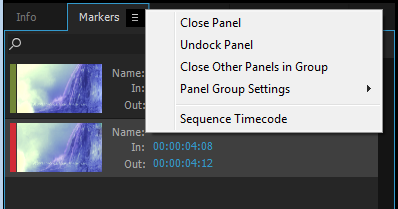
To display sequence timecode:
- In the markers console menu, select the Sequence Timecode option. The marker console timecode brandish changes from clip to sequence timecode.
When in sequence timecode style, only the prune markers in the current sequence are displayed in the Markers panel. Any prune markers outside the in/out range of a clip are not shown. Sequence timecode automatically updates if sequence timebase is changed.
Sharing markers with After Effects
You lot tin can share markers between Premiere Pro and After Effects in any of the following ways.
-
When yous import a Premiere Pro projection into After Furnishings, After Effects converts the sequence markers to composition markers.
-
When you copy a sequence from a Premiere Pro Project panel and paste information technology into Later on Effects, the resulting composition keeps the sequence markers as composition markers, and the clip markers as layer markers. The copy-and-paste functioning therefore preserves the markers in the way you lot would wait.
-
When you consign a sequence from Premiere Pro through Adobe Media Encoder into a container format, such as AVI, the sequence markers are saved into the file every bit XMP temporal metadata. When you use the video file equally the source for a layer, Later on Effects converts these sequence markers to layer markers.
Source: https://helpx.adobe.com/premiere-pro/using/markers.html
0 Response to "How To Set A Marker In Adobe Premiere"
Post a Comment